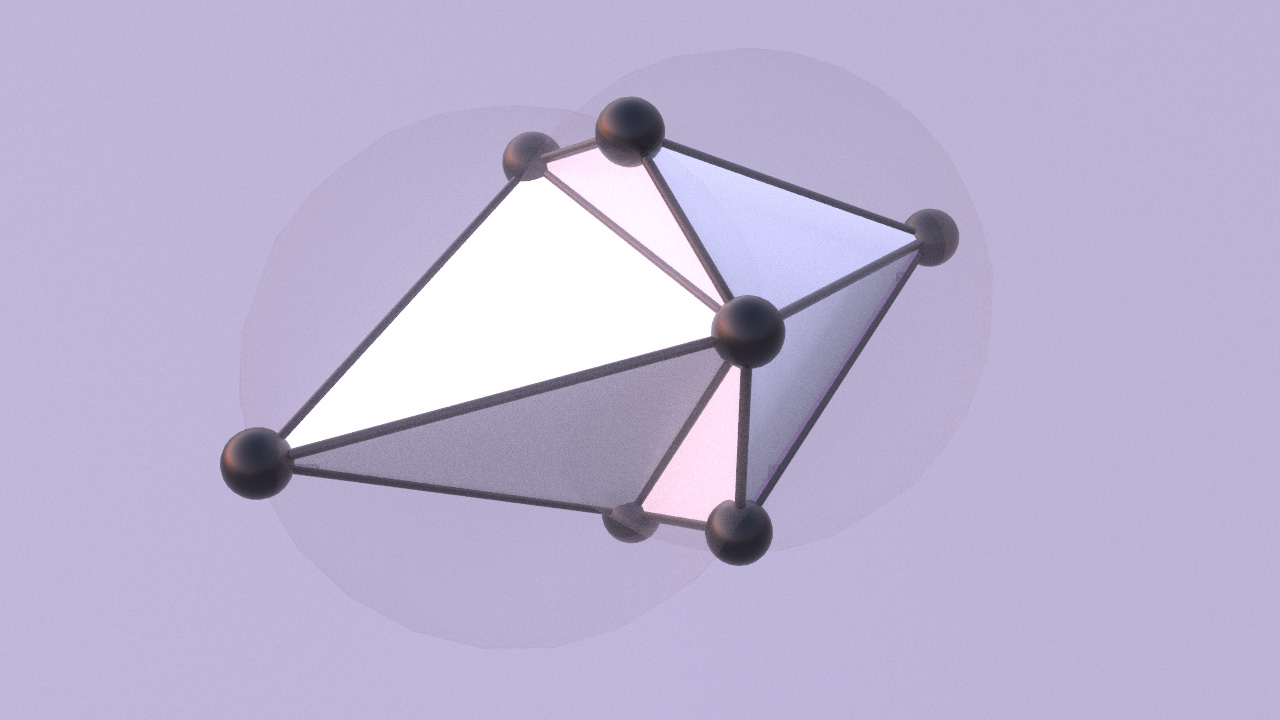
There are some interesting analogies between the mean curvature spheres of a smooth surface and the edge circumsphere of a triangulated surface in space. This got me thinking: is there a discrete version, using these edge circumspheres, of Hopf’s celebrated theorem that the only constant mean curvature surface homeomorphic to \(\mathbb{S}^2\) is the round sphere? Unfortunately, the most direct translation of the statement, replacing the mean curvature spheres with the edge circumsphere, in the discrete setting fails:
Let \(M=(V,E,F)\) be a manifold closed finite triangulated surface with vertex positions \(f : V \to \mathbb{R}^3\). Assume that for every edge \(ij\) incident to faces \(ijk\) and \(jil\) that there is a unique sphere \(S_{ij}\) going through the four points \(f_i, f_j, f_k, f_l\). Is it true that if the radius of \(S_{ij}\) is equal to \(1\) for every edge \(ij\) that there exists a single sphere \(S\) of radius \(1\) such that \(S_{ij} = S\)?
For every triangle \(ijk\) we have a circumcircle containing the three vertices, and in the elliptic sphere pencil generated by the circles there are exactly two unit spheres. To produce a counterexample to this claim, we can use multiple triangles inscribed in the same circle as a way to transition between these spheres while maintaining unit radius circumsphere.
The Counterexample
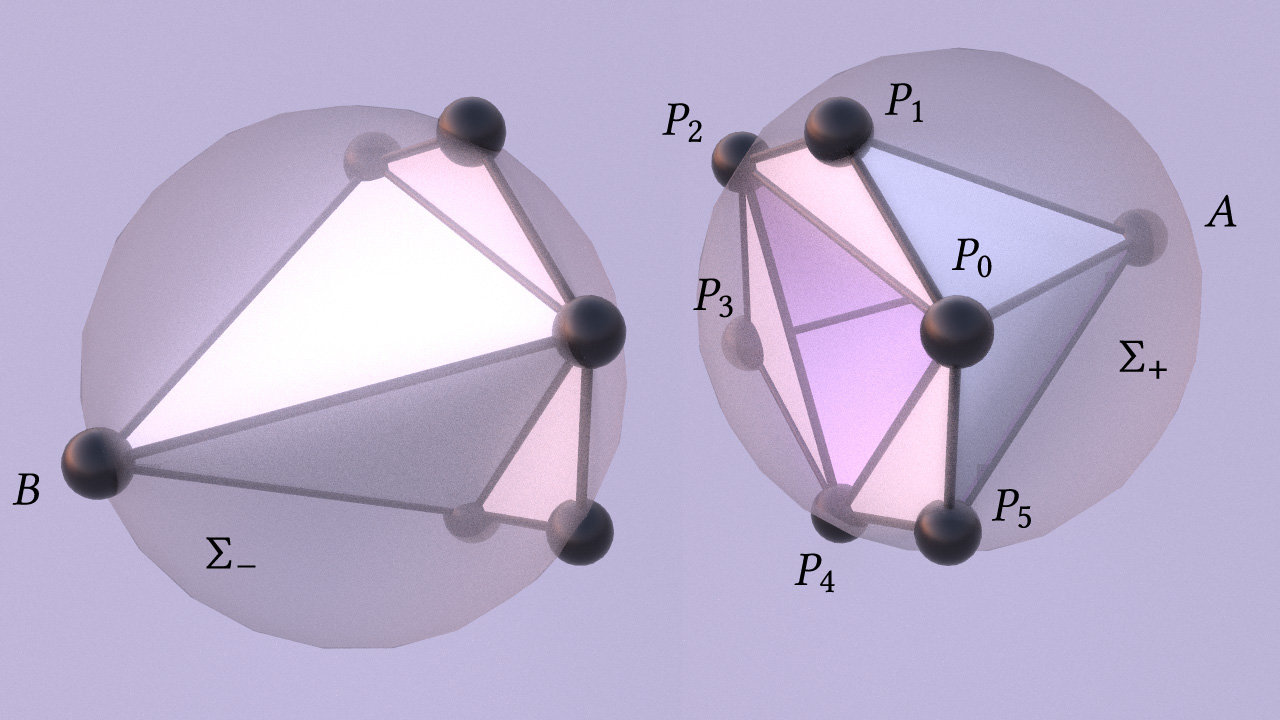
Explicitly, we consider \[ A = (0,0,3/2),\qquad B = (0,0,-3/2),\] along with six points (for \(k=0,\dots,5\)) on a circle in the \(xy\) plane: \[P_i = r \big(\cos\tfrac{k\pi}{3}, \sin\tfrac{k\pi}{3}, 0\big), \qquad r = \tfrac{\sqrt{3}}{2}. \] The two unit spheres in the elliptic sphere pencil containing this circle are \(\Sigma_\pm\) centered at \((0,0,\pm 1/2)\). We have that \[A,P_0,\dots,P_5\in\Sigma_{+},\] \[B,P_0,\dots,P_5\in\Sigma_{-}.\]
The triangulated sphere is then constructed with vertex set \[ V = \{A,P_0,P_1,P_2,P_3,P_4,P_5,B\}, \] and face set \begin{align*}F&=\{(A,P_0,P_1),(A,P_1,P_2),(A,P_2,P_3),(A,P_3,P_4),(A,P_4,P_5),(A,P_5,P_0)\}\\&\quad \cup \{(P_0,P_1,P_2), (P_2,P_3,P_4),(P_4,P_5,P_0)\} \\ & \quad \cup\{(B,P_2,P_0), (B,P_4,P_2), (B,P_0,P_4)\}\end{align*}
The first row contains faces which are inscribed in \(\Sigma_+\). The last row contains faces inscribed in \(\Sigma_-\), and the middle row contains faces inscribed in both spheres (see the exploded view above). It is clear to see that the edges connecting $A$ all have their circumsphere in $\Sigma_+$. Similarly, all of the edges connecting $B$ have their circumspheres in $\Sigma_-$. The outer edges of the three middle flat triangles have their circumsphere equal to $\Sigma_+$, while the three inner edges have their circumsphere equal to $\Sigma_-$. Therefore, we have an example of a triangulated sphere where all of the edge circumspheres have unit radius but all of the vertices are not cospherical.
Leave a Reply